
Willows for Winter
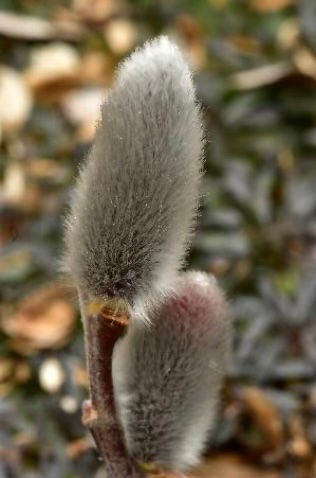
It’s February! Although the garden is still emersed in winters grasp, February brings growing signs that spring is not far away. Evergreens are certainly one stalwart sign of life, yet there are a number of plants with colorful stems or unfurling flower buds that show the garden is still very much alive despite the temperatures. One plant whose buds are showing signs of life is the Willow, botanically known as Salix. Often overlooked for reasons unknown, there are several species that provide the perfect addition to every garden for their wonderful tactile interest (the silky buds of Salix chaenomeloides are pictured below in February)!
Salix is a member of the Salicaceae or Willow Family and consists of over 350 species along with numerous, naturally occurring hybrids. The genus covers a broad geographic range with species native to North and South America, Mexico, the West Indies, Europe, Africa and Malaysia. Equally as broad ranging are the forms, which can vary from tall trees to arctic species barely reaching a few inches tall! The genus of Salix was officially described by the Swedish botanist Carl Linnaeus (1707-1778) in 1753 and is from the Latin Salices or Salix for Willow Tree. The Latin name may have originated from the Celtic words Sal, meaning near and Lis for water – all told a most appropriate name considering how Willows appreciate moist soils! However, the name Salix has also come to inspire other connotations. Dating back to the times of the Greek physician Hypocrites (460-370 BC), it was known that chewing the bark of White Willow (Salix alba) or sipping a tea made from the leaves would help reduce swelling and fevers. In 1829, the French pharmacist Pierre-Joseph Leroux extracted a compound from Queen of the Prairie (Filipendula ulmaria) that had similar beneficial properties and he called it Salicin in recognition of the Willow. It later came to be known that the Willow also contains this compound. Finally, in 1897, Felix Hoffman of the Bayer Company in Germany created an artificial form named Salicylic-acid – the active ingredient in aspirin! Every time you take an Aspirin for aches or pains, think of how this beneficial drug all began with the Willow!
Despite the many species of Willow, the Pussy Willow with its alluring flower buds is probably the most familiar to gardeners. Willows are dioecious, whereby certain plants produce only male flowers while others only female. The soft and silky floral structures we so adore are botanically called aments, or more commonly catkins. This name is derived from the old Dutch word Katteken for kitten, making it easy to understand how the common name of Pussy Willow came to be known. Its common name is often glorified in folk tales, such as an old Polish legend described in an article from the Arnold Arboretum (March 2024). As the tale goes, kittens were chasing butterflies by a stream when they mis-stepped and fell into the stream. Hearing the anguished cries of the grieving mother cat, the Willows bordering the stream dipped their stems into the water and plucked the kittens to safety. Every year since, the fur-like catkins appear where the kittens originally clung to the stem!
Catkins consist of a central stem around which the male or female flowers are tightly packed, much like corn on a cob. These flowers also lack the typical whorls of petals and sepals. Each individual flower is subtended and protected by a small leafy floral bract, from which the much-beloved hairs project. These hairs are botanically known as trichomes. The male flowered plants typically come into bloom first and tend to be showier than their female counterparts.

The overall structure is initially covered by a bud-scale that protects the flowers from the cold of deep winter as seen above in December for the Japanese Pussy Willow (Salix chaenomeloides).

With the warmer temperatures of mid to late February, the bud-scale is shed (as seen above in mid-February), whereupon the catkin enlarges to upwards of 1½-3” in length. The growth of the silky trichomes accompanies the shedding of the bud-scales and these ‘hairs’ also serve to protect the developing flowers within the catkin from late winter’s chill. As the flowers mature, the showier male flowers reveal red to yellow anthers protruding through the trichomes with most species pollinated via early rising pollinators, although some are also wind pollinated.
Not surprisingly, there are several species and hybrids sold in the trade as Pussy Willow. The showiest selections with the largest catkins are native to Europe and Asia. However, for those gardeners seeking to plant natives, Salix discolor is found throughout the northern regions of the U.S. into Canada. Commonly known as Glaucous Willow owing to the silvery and waxy undersides of the slender, 3-5” long leaves, Salix discolor becomes a large shrub reaching heights of 15-20’ by widths up to 12’. It was described in 1803 by the American Minister and Botanist Gotthilf Heinrich Ernest Muhlenberg (1753-1815). The species epithet means ‘of two colors’, since the female catkins have a green tone while males are yellow. The silky gray male catkins reach 1-1½” long and although attractive, they are not as impactful as the introduced species. However, this species does serve as an important source of sugary nectar for early emerging native bees and as a host plant for several species of butterflies and moths.

The Willow with perhaps the largest catkins is the Japanese Pussy Willow (Salix chaenomeloides) which displays especially large, silvery white male catkins up to 3” long (as seen above)! The species was named in 1938 by the Japanese botanist Arika Kimura (1900-1996) who specialized in the Salicaceae. The species name describes the foliage and how similar it is to Flowering Quince or Chaenomales. The plants also become large and without pruning, this species can reach heights of over 30’! More recently, it is thought this is actually not a true species, but rather a naturally occurring hybrid between Salix gracilistyla, commonly named the Rosegold Willow and Salix caprea, the Goat Willow.
The Goat Willow is native from Europe to western and central Asia. Without pruning, it grows to 25-30’ tall by 15’ wide and once again it produces attractive male catkins, growing to 2” long. The species was described by Linnaeus in 1753 and is from the Latin for female goat. The species and common name most likely stem from a sketch of the plant being eaten by a goat! This illustration appeared in a book of herbals written in 1546 by the German botanist, physician and minister Hieronymus Bock (1498-1554). As one might expect, the plants do not seem to be preferred over any other by hungry goats!

By comparison, Salix gracilistyla was named in 1867 by the Dutch botanist Friedrich Anton Wilhelm Miquel (1811-1871) and is considered by some to be the most attractive of the Pussy Willows. Native to China, Korea and Japan, the species epithet means slender style and references the long and slender style of female flowers. The style is the slender stem that connects the pollen receptive stigma to the ovary. Compared to Salix chaenomeloides, the Rosegold Willow is far more diminutive in overall size and develops into an arching shrub of a mere 10-12’ in height and width. The common name of Rosegold Willow stems from the anthers rosy-red appearance (as seen above and below) when they initially appear before turning to orange and ultimately golden yellow. Even before the rosy-red anthers emerge through the furry trichomes, they provide the catkins with an attractive pink glow. It was introduced into the trade by Messrs. Barbier and Co. of Orleans France in 1895.

Two rarely seen male selections of Rosegold Willow are recognized for their distinctly red catkins. The selection named ‘Mt Aso’ (pictured at left) honors one of the largest volcanos in Japan, located on the island of Kyushu. The flowers resemble the red-hot lava seen flowing from the volcano and was selected in the 1970’s by Dr. Tsuneshige Rokujo, a medical doctor at Tokyo University and an avid plant collector. Following the flowers, the foliage continues to provide beauty through their attractive bluish blush, allowing plants to enhance the summer garden. To confuse matters, there is another cultivar in the trade named ‘Mt. Asama’, honoring the volcano Mt. Asama on Honshū, the main island of Japan. Supposedly, it was selected for the cut flower trade by a florist in Japan. Both are beautiful plants and there is speculation that they could in fact be one in the same.

Another interesting form of this species is Salix gracilistyla var. melanostachys, which is also sold under the cultivar name of ‘Melanostachys’ (as seen above). It was initially introduced into Europe from Japan before making the voyage to the US around 1950. The botanical name is derived from the Greek Melano for very dark and Stachys for spike, describing the nearly black catkins. It too is a male flowered form, yet by comparison to the straight species the dark, reddish purple floral bracts lack the traditional silky trichomes. The young anthers within are a deep molten lava red and as they emerge, they transition to bright yellow as the pollen is shed. As with the pink flowered forms, plants mature to around 10’ tall and wide without pruning.

Although these catkin bearing Willows do not produce a perianth (petals and sepals) to beckon forth pollinators, the flowers are fragrant and also produce copious amounts of nectar for attracting pollinating bees and flies. Certainly, no need for a showy perianth during a season with little floral competition! Following bloom, all these species and selections benefit from a harsh pruning every one to two years. Termed coppicing or stooling, the plants should be cut back to the approximate height of a stool leg or 8-12” tall. This encourages long slender shoots to develop (as seen above) that not only provides a more appealing form, but allows the plant to display the catkins to their very best advantage. This pruning also helps to keep the size of the plant in check since once they have grown too large, their appeal is often lost. It is important to start this pruning when the plants are young to reduce wounds to larger stems and potential decay.

Buds aside, Willows can also provide winter interest through colorful stems, such as the Coral Bark Willow (Salix alba var. vitellina ‘Britzensis’). Known for its fiery orange-red stems, I initially read about this selection in English gardening books long before I had the opportunity to see them in Arboreta. In fact, I am still amazed it has not become a winter garden staple in the U.S.! The species epithet of alba refers to the glaucus white coloration of the leaf undersides and was described by Linnaeus in 1753. As one might suspect, its common name is White Willow and it can reach arborescent heights near 80’ tall! The variety vitellina is noted for bright yellow branches on the new growth and was originally named Salix vitellina by Linnaeus in 1753. Vitelline means yolk-like and describes how the stems resemble the golden color of an egg yolk. It was not until 1812 that the English physician and botanist Jonathan S. Stokes (1755-1831) described it as a variety of White Willow. I should note that this variety is very attractive in its own right for brightening the winter landscape. This variety is seen above right at the JC Ralston Arboretum in mid-September and the stems are already showing their yolk-yellow constitution! In addition, a few stems have already been pruned in the image, revealing how close to the ground this plant is annually stooled.

The cultivar ‘Britzensis’ recognizes the town of Britz Germany where this selection initially appeared. It was a seedling at the famed Späth Nursery and was introduced into commerce in 1878. The spectacular orange-red stem coloration is most pronounced during the first three years of growth and as the stems grow older, they gradually turn to a dull grey. Once again, the plants benefit from being stooled to rejuvenate the stems and stem color, a practice best performed every year for residential gardens due to the vigorous growth rate. The plants will rebound with 5-8’ of new growth the following summer, so you need not worry about a sizable hole in the garden for long! The image above and at right is the same plant before and after pruning. It was annually coppiced to 12” tall, allowing it to remain in scale for the backdrop of a mixed border.

The blue arrow points to the plant following pruning. I should also note that the root system was not overly vast and did not compete with the neighboring perennials for moisture. At the Frelinghuysen Arboretum in NJ, a plant was cut back that had not been pruned for an extended period, leaving 4” diameter stubs following the harsh stooling. The plants responded with 10-12’ of new growth, showcasing how pruning them annually serves to keep the plants more compact and in scale with the garden while not diminishing their vigor in the least! During the summer, the stems appear as a dull red and do not exhibit their rich colors until cooler temperatures return.
One additional red-stemmed selection that is great for winter interest, as well as for additions to floral centerpieces is Salix x ‘Swizzlestick’ (pictured below left). Although the parentage remains a bit of a mystery, it is thought that Salix alba is part of the lineage. The reddish orange stems twist upwards in a corkscrew fashion, appearing as if they are in perpetual motion! Once again, it benefits from an annual pruning, with the new growth twisting upwards to over 5’ tall!

All the selections mentioned are hardy in zones 4-8, although Salix gracilistyla var. melanostachys is more tender and listed as zone 5. If your garden features large containers, these plants make wonderful additions for winter interest. Although the botanical name recognizes Willow’s love of water, they are very adaptable and will grow with vigor in soils of average moisture. The one criterion for best growth and visual appeal is full sun! For Salix alba var. vitellina ‘Britzensis’, the effect of the stems is even more intoxicating if provided with an evergreen backdrop or lit by the low afternoon sun of winter!
Yes, it is February! A month that will always have its cold and snowy days, but plants such as these many forms of Willow provide both color and a tactile lure that pulls the gardener back outside and into the garden. They are also great for viewing from inside the house or adding a touch of fun and amusement to floral arrangements. Whatever the use, it is beyond a doubt that Willows are for Winter!

Bruce Crawford
Manager of Horticulture, Morris County Park Commission


Comments