
The Frosting on the Gardener’s Cake
In this age of readily disseminated literature and specialty nurseries delivering novel and little-known plants to your doorstep, logic would have it that all the intriguing and easily grown plants would be well-known and readily available for purchase. Should a gardener needed to evaluate a plant further, they would need only visit their local public garden where they could see these unique gems firsthand. However, some very good plants have managed to sidestep public gardens and literary plant sleuths alike. A great example is Orixa japonica ‘Pearl Frost’ (pictured below in early June). First introduced to me through good friends in the nursery industry, this beautifully variegated shrub has proven to be an ironclad plant for the garden!
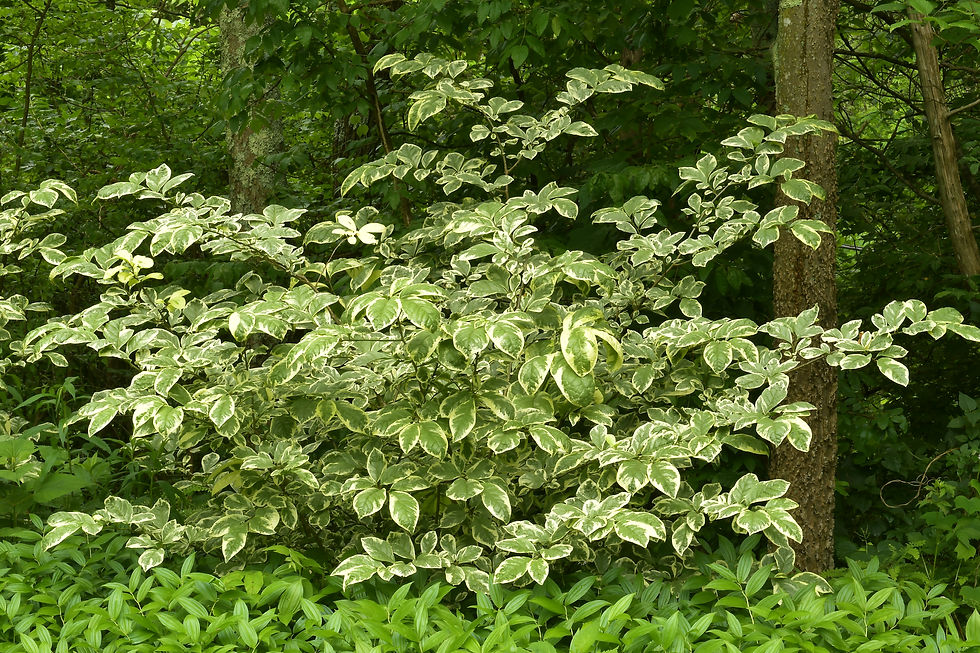
Commonly known as Japanese Orixa, Orixa is a member of the Rutaceae or Citrus Family and is a monotypic genus, meaning the genus only has one species. Plants appear on forested slopes at elevations between 1,500 and 4,000 feet in China, Japan and South Korea. It was named in 1783 by the Swedish physician and naturalist, Carl Peter Thunberg (1743-1828) from plants he studied in Japan. The genus name supposedly originated from the Japanese name for the plant, although it is currently known as Kokusagi in Japan. Oddly, and only a mere 11 years later, Thunberg named and described another specimen of this plant as Celastrus dilatatus, placing it in the Bittersweet Family. This name was rejected since the first correct description and botanic name is the accepted name. It is interesting how the name of the plant seemed almost as elusive as the plant is to gardeners today! The species epithet honors it native provenance of Japan.
Orixa japonica as a species is certainly an attractive plant in its own right. The glossy, dark green and obovate leaves are initially borne on an upright shrub that slowly becomes more broad spreading with age. Plants reach upwards of 10’ tall with widths exceeding 10’. The plants are diecious, with individual plants bearing only female or male flowers, a strategy plants adopted to prevent self- pollination. For ‘male’ plants, upwards of 10-12 pollen bearing flowers appear along short racemes (as seen below) while the ‘female’ plants bear flowers singularly. The ¼-⅜” wide flowers appear from the leaf axils of the previous year’s growth and have 4 green petals. The male flowers display 4 prominent anthers, as seen above on ‘Pearl Frost’ in late April. The female flowers give way to a 4-lobed fruit, roughly one inch in diameter that ripens in October. Each of the raindrop shaped lobes contains one black seed. As the two layers of the pericarp (the ripened walls of the ovary) within the pod dry and contract, they suddenly snap and literally propel the seed out of the pod through a slingshot-like action termed explosive dehiscence!

Although the species is attractive, neither the flowers nor fruit are able to compete with other glossy, green-leaved ornamentals such as Carolina Allspice (Calycanthus floridus). However, ‘Pearl Frost’ has far more to offer with its attractive green foliage bordered by an irregular greyish-white margin. Introduced by plant guru Barry Yinger, the plant resembles the straight species in every aspect except for the foliage. Unlike the brevity of the inconspicuous flowers, the foliage provides wonderful interest from April through October! The glossy foliage begins to appear around mid-April in northern New Jersey and initially sports a bright green center with a bold yellow border (as seen below).

Come May, the foliage matures into a refined pattern combining a central splash of light and dark green with a greyish white border (as pictured below).

At dawn and dusk, the leaf color comes alive and plants literally seem to glow! Unlike many variegated plants, the coloring remains steadfast and does not fade nor scorch during summer’s heat. It is also a strong grower - the plant in the closing image is a mere 6 years old and grew from a 4” pot! In my experience, it also fails to revert. ‘Pearl Frost’ produces male flowers and typical to the species, the crushed leaves produce a pleasant, spicy fragrance that renders the plant resistant to deer browse. With the advent of November’s chill, the leaves turn an attractive orange-yellow throughout the center with a pale-yellow margin (pictured below).

As an interesting sidebar, the positioning of the leaves around the stems of Orixa japonica has spawned new insight into the mathematical arrangement of leaves. Mathematics have long played a role in explaining the structure of plants. For example, the Fibonacci Sequence mathematically explains the spiraling arrangements of disc florets in Purple Cone Flowers (as seen below).

We typically think leaves are arranged in rows along opposite sides of a stem, but careful observation reveals otherwise. The leaves are usually organized around the stem in different geometric patterns called Phyllotaxis. These arrangements can readily be seen by looking down a stem and noticing how the angles between adjacent leaves change as the leaves rotate around the stem from the lowest region to the tip. This permits the plant to enhance its photosynthetic ability since the upper leaf does not cast shade on the leaf below and illustrates the benefit for each leaf having its ‘own space’ so to speak. Very ‘smart’ are these plants!

In the image at right of ‘Pearl Frost’, the leaf petioles can readily be seen originating at different points around the axis of the stem. Plant physiologists have long worked to create various mathematical equations that would explain these rotating leaf arrangements and the unique leaf arrangement in Orixa has been termed Orixate Phyllotaxis. Starting with the lowest or proximal leaf on a stem and proceeding towards the distal tip, the angle around the stem between the first two leaves is 90°; the angle between the second and third leaf is 180° since the third leaf is located on the opposite side of the stem; the fourth leaf is at 90° to the third and the following is 270° to the fourth before the pattern repeats. Beginning around 2010, plant physiologist Dr. Munetaka Sugiyama and his team at the University of Tokyo have been developing a mathematical equation to help explain this phenomenon of how the bud primordia are formed in this 90°, 180°, 90°, 270° sequence. It is thought to be a response triggered by the movement of the plant hormone Auxin within the stem as the stem elongates and grows. Not only does this plant make a great visual addition to the Garden, but it gives you cause to think about geometry! This geometric sequence is shared by other ornamentals, such as Crapemyrtle (Lagerstroemia indica) and Red-Hot Poker (Kniphofia uvaria).
For the Garden, ‘Pearl Frost’ provides all the subtle qualities deserving of a fine garden plant! Although tolerant of full sun, it performs best in light shade where the foliage serves to brighten shady woodland gardens or dark corners. Hardy in zones 6-8, plants prefer humus rich yet well-drained soils and I have seen it growing equally as well in acidic and near neutral soils. During the summer and fall drought of 2024, well established plants failed to show any duress. In Japan, the species is often used as a hedging plant, although I prefer its natural, vase-shaped appearance. ‘Pearl Frost’ looks great mixed with blue or lavender flowering companions, such as Virginia Bluebells (Mertensia virginica) or Siberian Bugloss (Brunner macrophylla). It also works marvelously well with variegated plants such as Variegated Fairy Bells (Disporum sessile ‘Variegatum’), Variegated Broadleaf Sedge (Carex siderosticha ‘Variegata’) and Variegated Solomon’s Seal (Polygonatum odoratum ‘Variegatum’). It is pictured below in June with a pink flowered Beardtongue (Penstemon). Also, try pairing it with white flowered plants such as Foam Flower (Tiarella cordifolia) or the 2-3’ tall White Flowering Onion (Allium ‘Mt. Everest’).
Variegated plants often appear garish or attract far too much attention to warrant use in a more cohesive garden design. This is certainly not an issue for Orixa japonica ‘Pearl Frost’. It is a great ‘team player’ for woodland gardens, offering an attractive yet elegant glow throughout the season. This may not be a plant you find at the local garden center, but it is worth a search of specialty nurseries for this gem. Without doubt, it is the Frosting on the Gardener’s Cake!

Bruce Crawford
Manager of Horticulture, Morris County Park Commission


Comments