
Beauty is Worth a Second Attempt
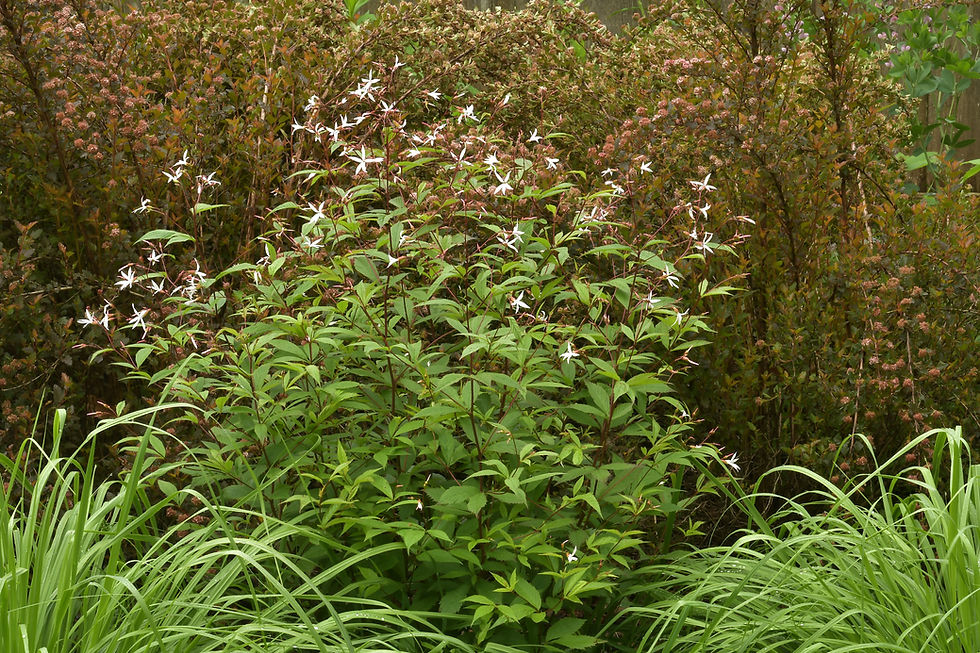
I am not certain if it is forgetfulness or simply a lack of patience, but I am always astonished at the number of times I have grown a plant unsuccessfully and opted not to try it again until many years later. A case in point is Bowman’s Root, botanically known as Gillenia trifoliata (as seen below in late May with a backdrop of Physocarpus Coppertina®). I remember exactly where I planted it in 1987 at a garden in Hawthorne, NJ and I did not give the plant much consideration again until some 35 years later! Granted, I neglected to properly locate the plant, but every gardener knows the importance of trialing a plant again and again. Luckily, I finally decided to grow this plant again, and this time with great success (as seen below at Willowwood Arboretum)!
Gillenia is a member of the Rose Family or Rosaceae and consists of only two species, both native to Eastern North America although their distribution differs sightly. Gillenia trifoliata was originally placed in the genus Spirea by the Swedish botanist Carl Linnaeus (1707-1778) who named it Spirea trifoliata in 1753. It was properly renamed Gillenia trifoliata in 1802 by the German botanist Conrad Moench (1744-1805). The name honors the German botanist Arnold Gill (1586-1633), who wrote about horticulture and developed a public garden in the town of Kassel, Germany.
As is true of so many plants, the name failed to remain steadfast and ultimately resulted in much confusion over the plant’s correct botanical name – confusion that persists to this day! The problem with Gillenia began nearly 40 years prior in 1763 when the French botanist Michel Adasen (1727-1806) also wished to honor Gill by naming a plant Gillena, which lacked the second “i”. Interestingly, Adasen was proposing this name for a plant that is now accepted as Clethra (Pepperbush). Believing the genus of Gillenia was improperly named since Gillena was crafted first and is so similar, the American botanist Nathaniel Lord Britton (1859-1934) proposed altering the name to Porteranthus in 1894. Britton was certainly no slouch in the world of botany and horticulture. He co-founded the New York Botanic Garden in 1891 and ultimately described over 1,200 plant species, making his opinion very well regarded in horticultural circles! Porteranthus honors the American botanist and theologian Thomas Conrad Porter (1822-1901). Ultimately, Britton’s suggestion was disqualified and both Clethra and Gillenia with a second “i” were accepted as proper and valid. Although Porteranthus was properly published, it was technically superfluous and should have been discounted at the start. Unfortunately, the damage was done and Porteranthus is often displayed as the name in Garden Centers and nursery catalogues. I would like to believe confusion over the name was the reason I was reluctant to try this plant again sooner, although I know that was not the case! The species name of ‘trifoliata’ describes how the compound leaves are arranged in clusters of three, as seen in the image below.

Although the story of the botanical name is a bit clumsy, the plant itself is anything but clumsy and is visually very elegant! Its slender red stems magically support the foliage and flowers, providing a light and airy quality for the garden. Gillenia is typically described as an herbaceous plant, even though it is technically a ‘subshrub’ and produces semi-woody stems near the crown that persist throughout the winter. Consistent with its shrub-like nature, plants also take 3-4 years to mature, which could be a detriment for gardeners who expect herbaceous plants to mature within two seasons. At maturity, the plants reach a height of 2-4’ tall by 2-3(4)’ wide and although seemingly large in size, the long 4-8” intranodal spacing between the leaves renders an airy, transparent quality that makes the plants’ mass appear far more modest. The light green lanceolate foliage varies from 1-4” long by up to 1” wide with serrate or sawtooth margins (as seen above). The leaves have a slightly puckered or quilted texture between the veins, playing beautifully against the deep red stems.

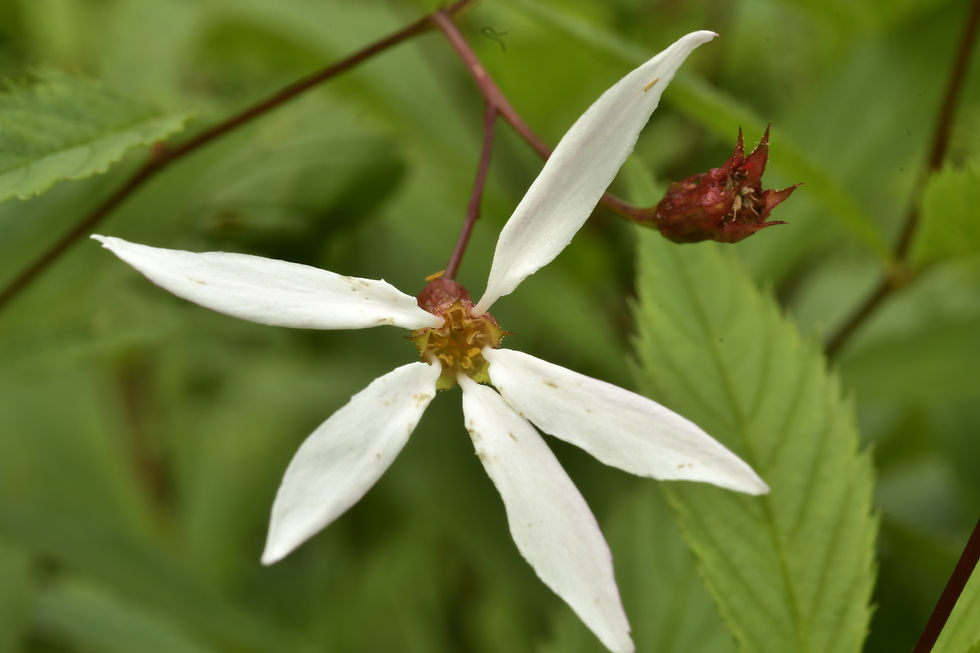
The flowers consist of five slender white petals and measure about 1” in diameter. They are borne on very open corymbs, embracing the plant’s overall airy texture. When in bud, the petals are twisted together, strongly resembling the beak of a bird (as seen above). The outer surface of the petals also bears an attractive red blush, complimenting the deep red hypanthium or floral cup at the base of the flower (as seen in the closing image). Once open, the stark white color of the flowers with their yellow central ‘eye’ allows them to visually ‘pop’ against the dark backdrop of the foliage. The color of the floral eye is from the numerous yellow stamens that line the inside of the cup-shaped hypanthium at the flower’s base. The hypanthium is formed by the red bracts of the calyx combined with the bases of both the petals and stamens. It functions to protect the anthers from unnecessary losses of pollen. Each petal arises from the region in-between the pointed floral bracts (calyx) of the hypanthium, as once again seen in the closing image. In New Jersey, flowers are produced from mid-May into July, whereupon the plant continues to maintain its shrub-like stature until frost. Come the shortening days of fall, the foliage assumes deep red and orange hues as seen below, providing yet another season of colorful interest.

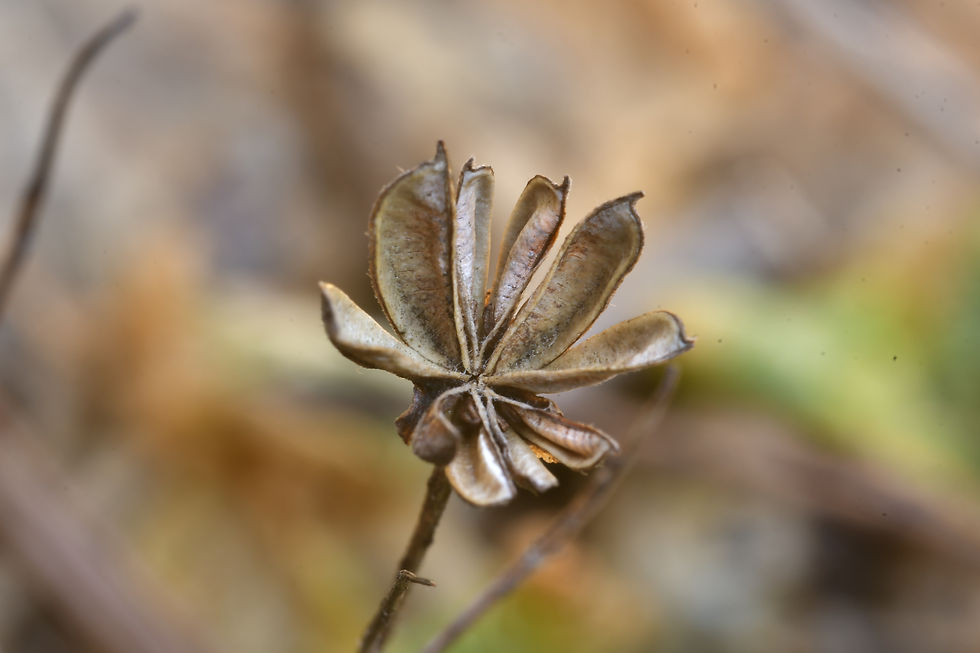
During winter, the slender stems seem to defy the elements and retain their overall shape until spring, although the foliage has now dropped. The bright red hypanthium transitions into a brown seed capsule which releases its numerous seeds after splitting open in early autumn. The open seed capsule pictured in late February still retains several seeds (seen below).
New to the trade is a pink flowered form named ‘Pink Profusion’ which also has foliage bearing a red glow. Although attractive, I still prefer the white flowered forms! For those living with deer, the plant has proven to be reasonably deer resistant, due to its cathartic and emetic (induces vomiting) properties. The root was long used by Native Americans for its medicinal properties, earning it the name of Indian Physic. The other common name of Bowman’s Root comes
from the 18th century Virginia botanist and physician Dr. John Bowman. The name honors his study of the Virginia flora, but it remains uncertain as to whether he actually prescribed the root to his patients!
Gillenia trifoliata it native from Ontaria to Georgia and Alabama, essentially following the Appalachian Ridge. As mentioned, there is also a second species named Gillenia stipulata, which has a more southern and western range, growing from Ohio to Kansas and south to Alabama and Texas. The plant looks virtually identical to its cousin, except for the large leafy stipules located at the base and on either side of the trifoliate leaves, inspiring the species epithet. In the image below, the arrow points to one of a pair of stipules. The floral stem or peduncle of a developing flower cluster can also be seen resting atop the central leaflet. The leaf margins are also more deeply incised than its cousin. The species was originally, yet incompletely described by the American botanist Gotthilf Heinrich Ernst Muhlenberg (1753-1815) as Spiraea stipulata and was validly published as Spirea stipulata by the German botanist Carl Ludwig von Willdenow (1765-1812) in 1809. Only a few years later in 1817 it was properly renamed Gillenia stipulata by the English Botanist Thomas Nutall (1786-1859) who extensively explored North America from 1808-1841, except for briefly returning to Britain during the War of 1812.

Both species are hardy in zones 4-8 and appreciate well-drained humus rich soils. In the wild they are often found on rocky hillsides and in light shade where the pH ranges from near neutral to acidic. On a recent trip to the Shenandoah National Park, I discovered Gillenia trifoliata growing in combination with Mountain Laurel (Kalmia latifolia), Pinkster Azalea (Rhododendron periclymenoides) and an unusual Azalea called Minniebush (Rhododendron pilosum), highlighting its adaptability to acidic soils and shade! Plants tolerate full sun, although some protection from the hot, midafternoon sun is appreciated, which was my initial undoing in Hawthorne where I grew the plant in full sun on a steep slope. At Willowwood, Gillenia trifoliata is sheltered from the midday sun by tall grasses and the shrubby Coppertina Ninebark (Physocarpus opulifolius Coppertina®), where they have prospered. The foliage of Coppertina also pairs very nicely with the red stems of Gillenia! The slender and wispy nature of the plant allows it to pair well with plants having a bolder or denser texture, such as Pig Squeak (Bergenia cordifolia), Bear’s Breeches (Acanthus hungaricus) or even a groundcover of Foam Flower (Tiarella cordifolia) – all ideal companions for locations with light shade. Seedling grown plants will noticeably vary between 2-4’ in height. If this proves distractive to a design, consider interplanting Bowman’s Root with transparent ornamental grasses like Tufted Hair Grass (Deschampsia cespitosa) or any of the numerous Sedges (Carex spp.) that tolerate the afternoon shade, while distracting the eye from the variable height of the Gillenia.
One rule that all Gardeners certainly understand is our innate ability to fail. Unfortunately, if lackluster results coincide with our first attempt, we often consider the plant to be at fault and not the gardener. By whichever genus of your choosing, Bowman’s Root provides the Garden with a magical, almost aristocratic airiness that is hard to find in plants. It also provides season long color and once again proves – elegance and beauty are definitely worth a second attempt!
Bruce Crawford
Manager of Horticulture, Morris County Parks Commission


Comments