
The Bold and Beautiful
By and large, spring ephemerals require a bit of trial and error before a gardener can understand how best to use them in the spring garden. By definition, this group of plants emerge in early spring, flower, set seed and enter dormancy all before or around the start of summer. Their strategy is to complete their annual reproductive cycle before the tree canopy is fully leafed-out and competition for sunlight and water becomes more intense. For the gardener, the challenge becomes how to display their beauty while accommodating for their declining foliage. This was my initial hesitation for using the bold textured Mayapple, botanically known as Podophyllum peltatum. Fortunately, time spent observing the plant in nature, such as in the Texas woodland pictured above right and working with the plant in gardens have resolved those fears!

Podophyllum is a member of the Berberidaceae or Barberry Family with the afore mentioned P. peltatum native to central and eastern North America and roughly 6 additional species native from Afghanistan east to Japan. Podophyllum peltatum was officially described in 1753 by the Swiss botanist Carl Linnaeus (1707-1778), although his inspiration for the name was from the French botanist Joseph Pitton de Tournefort (1656-1708). Tournefort named the plant Anapodophyllum canadense Morini, with the genus based on the Latin Anatis for duck, Podos for foot and Phyllon meaning leaf – all combined translating to Duck’s Foot Leaf! Linnaeus merely shortened the name! With a touch of imagination, each lobe of the leaf does resemble a duck’s foot, as seen best in the closing image. Pitton also championed the concept of genus and species, which was beginning to gain a following among botanists in the late 1600’s. The species epithet crafted by Linnaeus describes the peltate leaf, whereby the petiole or ‘leaf stem’ is attached near the center of the leaf’s lower surface and not along the leaf margin. As an aside, Sinopodophyllum of Western China and Afghanistan, and Dysosma of China and Indochina are two closely related genera that are very similar in appearance and are often listed as Podophyllum.

Mayapples form large colonies connected by underground horizontal stems called rhizomes. Each year the rhizome branches and spreads an additional 2-8”, with the stems appearing from buds located at the tip of the rhizome. The individual stems initially appear in early to mid-April in New Jersey, and are protected by white bracts (Fig. 1) that reach two inches or so above the soil before splitting open and allowing a single stem to emerge. Individual stems will have either one or two leaves, depending on the amount of stored carbohydrates in that particular rhizome segment. Stems with one leaf fail to have enough stored carbohydrates to produce a flower, while those with two leaves are more apt to bloom.
For flowering stems, the flower bud appears at the tip of the stem with the overlapping, dark green leaves appearing much like a pair of crossed arms (Fig. 2).
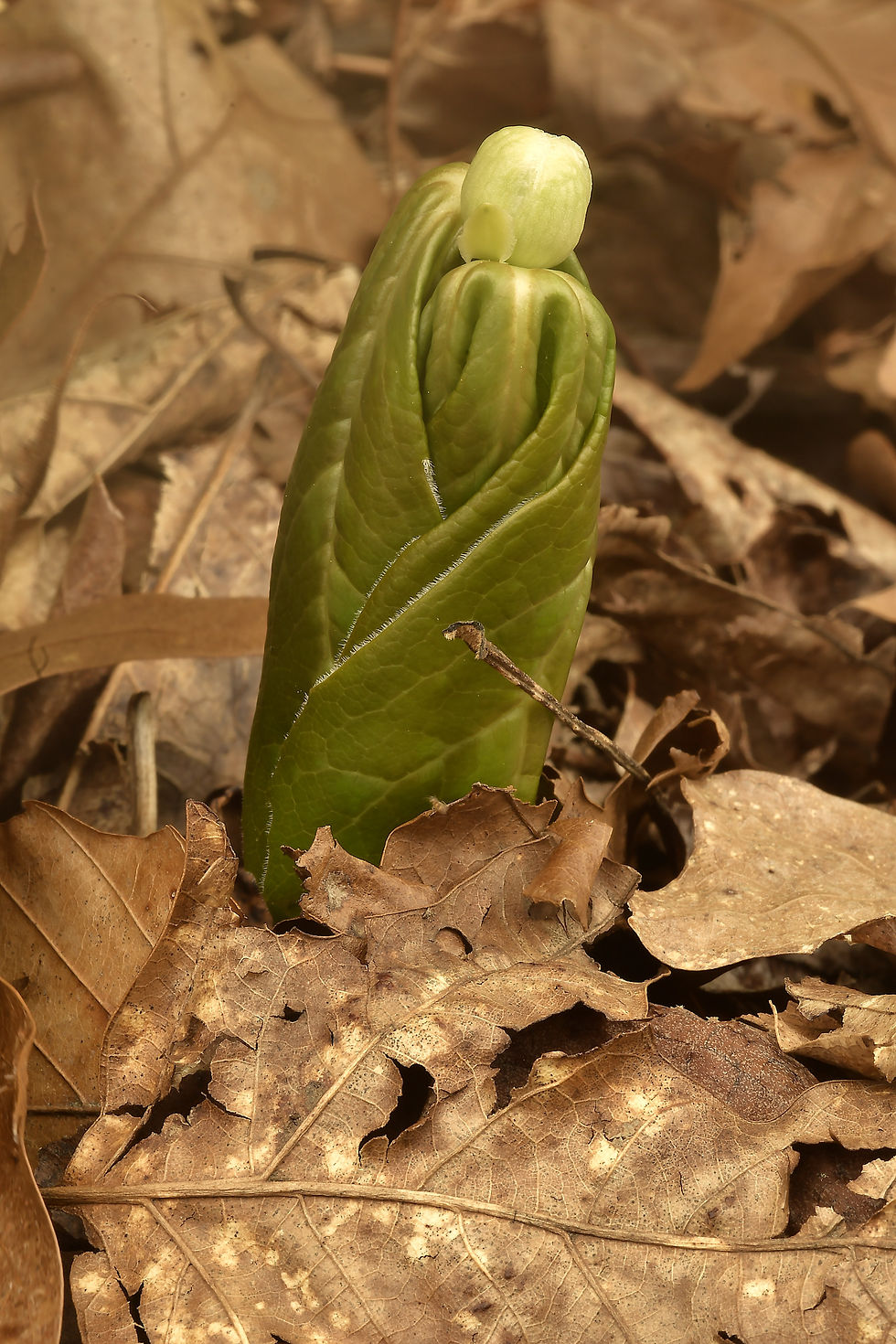
With a touch of imagination, the young plant resembles a miniature Count Dracula with the flower bud resembling a downturned head and the foliage assuming the appearance of a cape wrapped around the body! The body of course would be the sturdy stem that measures around ¼” in diameter and approaches 12-16” in height at maturity. Once the stem nears the mature height, the leaves continue to unfurl and stretch an additional 3-6” taller as the leaf petioles elongate.
Each peltate leaf is 12-14” in diameter with upwards of 9 deeply cut lobes. For those plants with two leaves, the point of petiole attachment becomes offset and is closer to the leaf margin (Fig. 3).


This allows the foliage to efficiently share the ‘airspace’ above a stem. For plants with one leaf, the point of attachment remains closer to the center of the leaf.
Interestingly, as the plant matures the flower bud transitions from being highly visible at the tip of the growing plant to becoming concealed by the expanding foliage, even though it remains perched at the tip of the stalk and in-between the two leaf petioles. As the stalk stretches upwards, the pedicel or floral stem also expands to 1½” long, remaining upright throughout the stalk’s growth (Fig. 4). Once the mature height is reached, the three sepals of the calyx fall to the wayside and the flower assumes a more downward orientation in an effort to provide protection from the elements (Fig. 4).


The white flowers (Fig. 5/6) typically open in May and were thought to resemble the blooms of an apple tree – hence, the common name of Mayapple! When fully open, the 7-9 petaled blossoms range from 2-2½” in diameter with a ring of yellow anthers surrounding a prominent globe shaped stigma and the pale green to yellow ovary beneath. Flowers have a light, musky fragrance and although lacking in nectar, they are rich in pollen. Flowers will not self-pollinate and require two genetically different parents with Bumble Bees often assuming the role as pollinator. It has also been shown that pollination is more successful when additional flowering plants with a high nectar content are nearby. This attracts pollinators who prefer to feed on nectar while still enabling them to bring the protein rich pollen back ‘home’ for their young after visiting neighboring Podophyllum plants.
Contrary to what many authorities claim about low fruit set, I have seen a good number of ‘apples’ on plants in Warren County, NJ! Technically, this ‘apple’ is actually a true berry since it develops from a single flower with one ovary. Round to egg-shaped in appearance, the ‘apples’ grow to 1½” in diameter and mature in late July and early August. The fruit is pictured [Fig. 7/8] in early July.

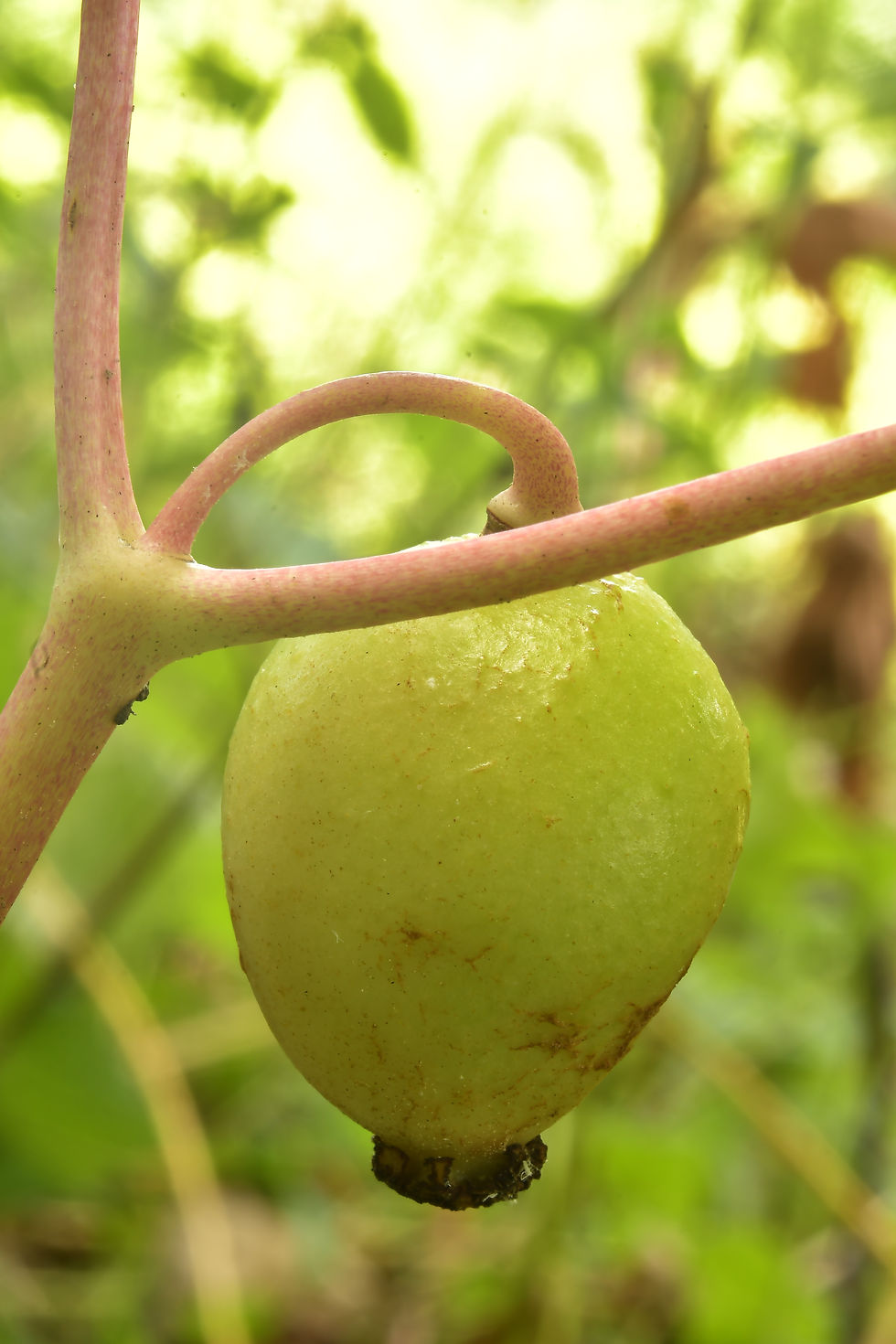
They are edible but only when ripe since the unripened fruit, as well as all parts of the plant, contains the toxic chemical Podophyllotoxin. I have always been hesitant to try something that may still be poisonous, but our wildlife is far more daring! The fruit is highly favored by the Eastern Box Turtle, although Raccoons, Opossums and even the occasional Black Bear are all thought to dine on and distribute the seed far and wide! Stalks that did not flower or failed to produce fruit will go dormant in June, especially if located in the sun while the foliage of fruiting plants remains into July.
If a Mayapple with foliage that persists until frost is preferred, consider Podophyllum ‘Spotty Dotty’! A cross conducted by Janet Egger of Tera Nova Nurseries, the plant was released in 2005 and has already become a well-respected aristocrat among Mayapples! The plant is a cross between the Chinese species Podophyllum delavayi and an open pollinated seedling borne from crosses among 3 Chinese species. Both parents have wonderfully spotted foliage which gave Spotty Dotty its distinct foliage marked with patterns of chocolate brown spots (Fig. 9).

This plant is once again rhizomatous, although it is far more contained than its rambunctious cousin. Similar to its cousin, the tip of the rhizome produces a single stem supporting one or two leaves, with the floral display only occurring on those stems displaying two leaves. As the stems push upwards from the rhizome, they are protected by the typical white bracts that split open in late March or early April to reveal the foliage (Fig. 10/11). Within 1-2 weeks, the light green, almost chartreuse leaves enlarge and drape downward, nearly obscuring the attractive red stem (Fig. 12). The stems are initially near ½” in diameter, but become more slender as they grow. They are also covered with attractive white hairs which persist through summer.


The newly emerging leaves of spring are surprisingly frost resistant, with the plant pictured above [Fig. 10/11] enduring an evening of 27°F without any initial damage, although one leaf did become somewhat distorted with time. As the foliage unfurls in late April, the light green leaves have random chocolate brown markings on the outer 2/3 of the leaf which, by June, have transitioned to dark green regions on a light green backdrop. The shape of the leaf also varies with time! On young, newly installed plants, the peltate leaves vary from somewhat square to octagonal in shape. Once established, the foliage becomes circular, reaching 12-14” in diameter with 6-7 lobes. Unlike Podophyllum peltatum, the lobes are not as deeply incised and the foliage persists well into fall, often shrugging off the early frosts of autumn.
For stems bearing flowers, the flower buds once again forms at the tip of the stem and in-between the two leaf petioles. The red flower buds are readily seen in the image above [Fig. 10/11]. Oddly, the flower buds of Spotty Dotty are much smaller than its cousin, although the flowers are ultimately far larger! Much unlike its cousin, there are typically five flower buds per stem that open to reveal deep red flowers with 5 dangling petals that nicely compliment the pubescent red stems (Fig. 13). Once again, the flowers are hidden by the foliage, but with those dramatic 1½” long petals, it is well worth the effort to peer beneath for a look! The plants are also self-infertile, but can cross with our native species to produce small, 1” diameter berries.

In general, all species of Podophyllum prefer a humus rich soil that does not become excessively dry. They also prefer the coolness of a shaded location, such as next to a large mossy rock should you have the good fortune! It is thought plants naturally develop mycorrhizal associations in woodlands, which assist with nutrient and water absorption. It takes time to develop these associations, and as a result, plants will take time to ‘settle in’ to their new locations. Podophyllum peltatum is tolerant of a broad pH range from 5-7 with an equally broad hardiness range, thriving in zones 3-8. Spotty Dotty prefers slightly more acidic soils with a pH range of 5.5-6.5 and is hardy from zones 6-9. They are both very easy plants to grow, although I have seen the Mayapple Borer tunneling through the stems of Spotty Dotty, resulting in the loss of that particular stem (Fig. 14).

Podophyllum peltatum ultimately needs a larger area to expand over time due to its more vigorous rhizomatous growth. In the garden, as the foliage declines during late spring and plants enter dormancy, Mayapples should be interplanted with other plants that distract the eye from the declining foliage. I have plants naturally growing beneath a groove of Prickly Ash (Zanthoxylum americanum) and Blackhaw Viburnum (Viburnum prunifolium) and I rarely notice when the plants enter into summer dormancy! They also work well when used in small masses below early blooming woodland shrubs, such as evergreen Rhododendron, Mahonia and deciduous Azaleas. For herbaceous combinations, consider combining them with the contrasting texture of ferns, especially those larger candidates like Ostrich Fern (Matteuccia pensylvanica) or, where soils are not droughty, Cinnamon Fern (Osmunda cinnamomeum). In addition, the ferns will help carry the garden through the summer once the Mayapples are dormant! Solomon’s Seal (Polygonatum biflorum) also works well for carrying the garden interest while providing an attractive contrasting habit as it arches up and over the Mayapples. For the less aggressive Spotty Dotty, consider Maidenhair Fern (Adiantum pedatum) or the Autumn Fern (Dryopteris erythrosora), whose golden orange young fronds nicely complement the chocolate leaf markings. If you wish to compliment the chartreuse portions of Spotty Dotty’s leaf, consider All Gold Japanese Forest Grass (Hakonechloa macra ‘All Gold’) (Figure 15). Combining plants with mottled foliage can also lead to a fun combination and you may wish to consider pairing Spotty Dotty with our native Alleghany Pachysandra (Pachysandra procumbens) whose foliage often displays copper colored patterns in late summer and fall.

Without doubt, spring ephemerals can be intimidating subjects to work into the garden, especially when the foliage is dramatically large! However, the fun of gardening is in trying new combinations and I have found that where naturally occurring, such as seen in the opening image, the declining foliage does not catch your attention since the plants appear randomly and not in a dense mass. Planting them randomly and in limited quantities provides the same effect in the Garden. Additionally, Spotty Dotty offers a more restrained option for season-long displays. Regardless of which plant you chose, they both provide that touch of whimsy when their beautiful leaves beckon you close for a game of hide and seek as you look for their hidden yet beautiful flowers! Certainly, a very playful reason to grow these bold and beautiful plants!

Bruce Crawford
Manager of Horticulture – Morris County Parks Commission


Comments