
A Most Alluring Rose
Without doubt, I appreciate the beauty and – for those selections so ‘gifted’ – the fragrance of a rose. Admittedly, for many years I was reluctant to include roses in a garden. Maybe it was my parent’s ill-fated attempts at growing them or the simple fact that many ‘bite’ should I get too close, but I simply was not sold on gardening with roses. Of course, it was only a matter of time before I changed my mind! Several years back I was smitten by the Smooth Rose, botanically

called Rosa blanda (pictured above in late May). Oddly, it was not the flowers that I found alluring. Rather, it was the interesting fruit and colorful stems of fall and winter combined with its relaxed and sprawling nature that garnered my interest!
Coming as no surprise, Rosa blanda is a member of the Rose Family or Rosaceae, a rather sizable family with 98 genera and over 4,800 species! The Smooth Rose is native to Eastern and Central North America, ranging from North Carolina west to Kansas and north to Nova Scotia and Saskatchewan. The genus name of Rosa is from the Latin for this group of flowering plants and was officially adopted as the genus in 1753 by the Swedish botanist Carl Linnaeus (1707-1778). This species was described by the Scottish Botanist William Aiton (1731-1793) who served as the Director of the Botanic Garden at Kew from 1759-1793. In 1789 Aiton composed a 450-page treatise of all the plants growing at Kew entitled Hortus Kewensis. Evidently, the Smooth Rose was growing at Kew at that time and had yet to be described! The species name is

from the Latin Blandus, meaning alluring or pleasant, certainly very befitting adjectives! Oddly, ‘Bland’ has come to mean tasteless or boring, which is anything but apropos for this rose.
Unlike most garden worthy roses, the Smooth Rose is rhizomatous and spreads to produce open thickets, rather than individual shrubs. For formal gardens, where plants are required to be unique individuals and not intermingle with their neighbors, this is decidedly not the appropriate plant. However, in cottage or meadow designs where plants intermingle (as seen above at Willowwood Arb.), this plant is ideal! The compound foliage is arranged alternately along the stems, with each leaf composed of 5-9 leaflets along a red-blushed central rachis (as seen below). Each leaflet is 1-1½” long by ¾” wide, with a serrate leaf margin. The leaves are highly

hydrophobic and after a rain or a heavy morning dew, beads of water coat the leaf’s surface (as seen below). The leaves also benefit the larva of a number of Lepidoptera and provide nesting material for native bees, illustrating how those partially eaten leaves are actually benefitting the ecosystem!
The flowers appear at the tips of lateral or side branches that develop along the older, woody stems. The blossoms may appear singularly or in groups of up to four and are loosely arranged
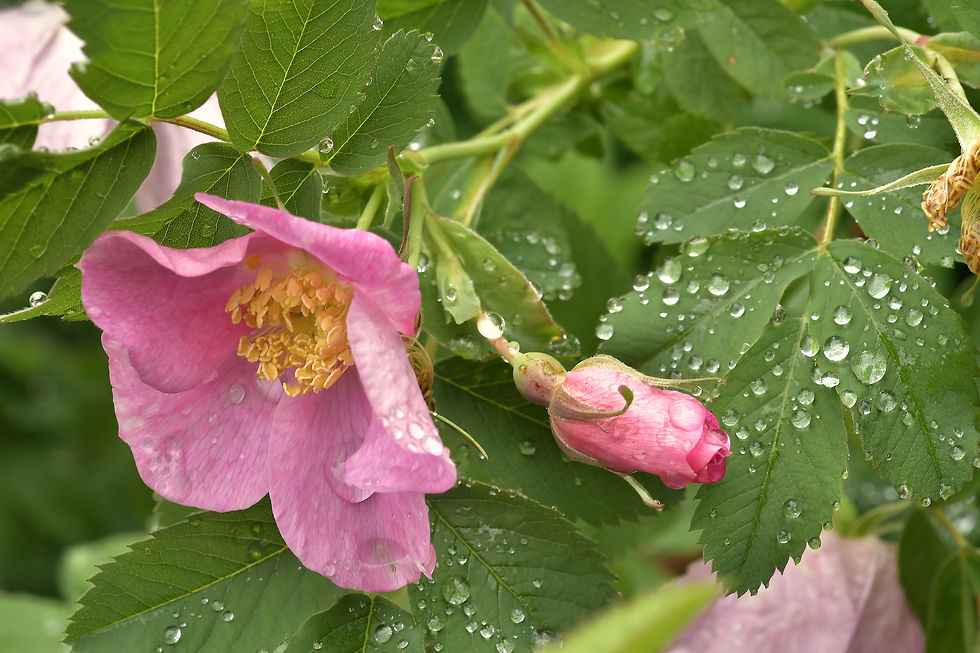
in a corymb-like structure. The 2-3” diameter flowers begin to appear around mid-May in Northern NJ and are finished by early June. The flowers are lightly fragrant with 5 obovate petals surrounding a ring of orange/yellow anthers and a central boss of much shorter and similarly colored female styles and stigmas (as seen above in late May). Following petal drop, the 5 slender and pointed sepals remain as the ovary beneath slowly matures into a bright red fruit or rose hip by late summer (pictured below in late October).

It was these ½-¾” diameter rose hips that first drew my attention to a Smooth Rose during one October. Roughly 1” long, they are bright red in color and appear in a very noticeable, upright orientation by the supporting pedicels (floral stems). The hips are not the only vestige of seasonal interest; as seen in the image below and the closing image, the foliage displays
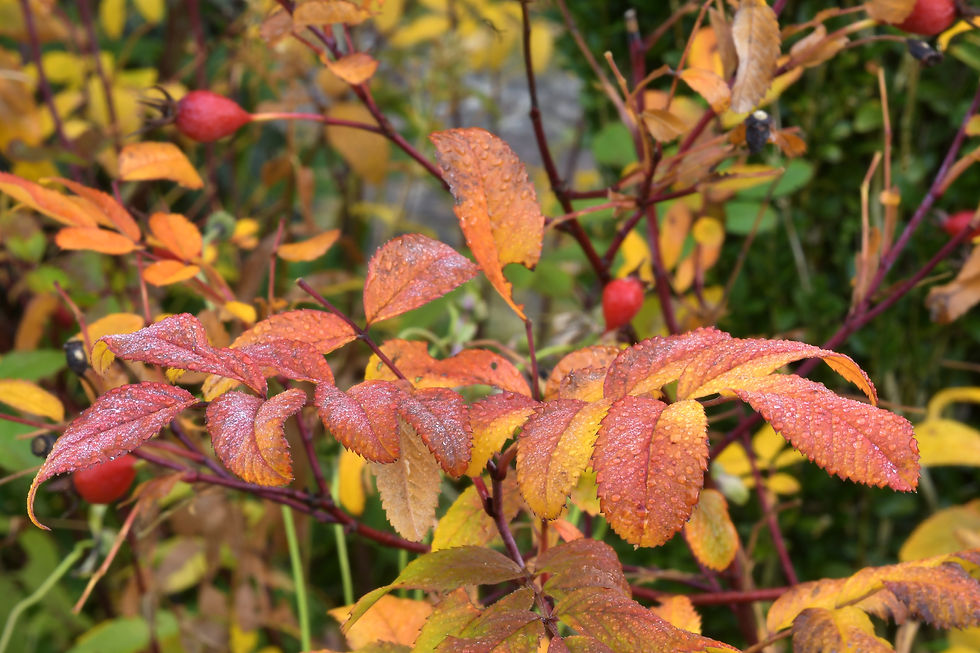
attractive orange and yellow fall colors while the stems develop an equally alluring rich red hue for winter interest! During the summer, the foliage amply covers the older stems and only the bright green new stems are exposed to inquisitive eyes. It is not until the foliage begins to drop that the developing red color of the older stems can be seen and appreciated. Another aspect of the stems I greatly appreciate is the lack of thorns, botanically known as prickles. Technically, a prickle is composed of the outer layer or epidermis of a stem while a thorn is a modified stem! After all those years of working around roses that seemed to attack when I was least expecting, finally a friendly rose! It is also the lack of prickles and the waxy smooth stems that led to the common name of Smooth Rose. Some prickles can still be found along the light brown base of the stems but fortunately, it is at a point where a gardener’s hand does not frequent. The beautiful red stems and hips remain throughout the winter and provide a source of food for a number of songbirds, upland gamebirds and mammals.
Rosa blanda is also called Meadow or Prairie Rose, owing to its frequent appearance in open prairies where it is highly tolerant of the exposed and blustery winter sites, explaining its hardiness in zones 2-6! It is the plant’s ability to create thickets in prairies or meadows that showcases the style of design for which it will best serve the gardener. Planting it where its natural habit can be appreciated best also eliminates the need to battle those spreading rhizomes! Consider mixing the rose with plants appropriate to a meadow or prairie, such as Bee Balm (Monarda fistulosa), Hardy Geraniums (Geranium maculatum), Culvers Root (Veronicastrum virginicum), or False Indigo (Baptisia australis). In cottage gardens it looks great mixed with
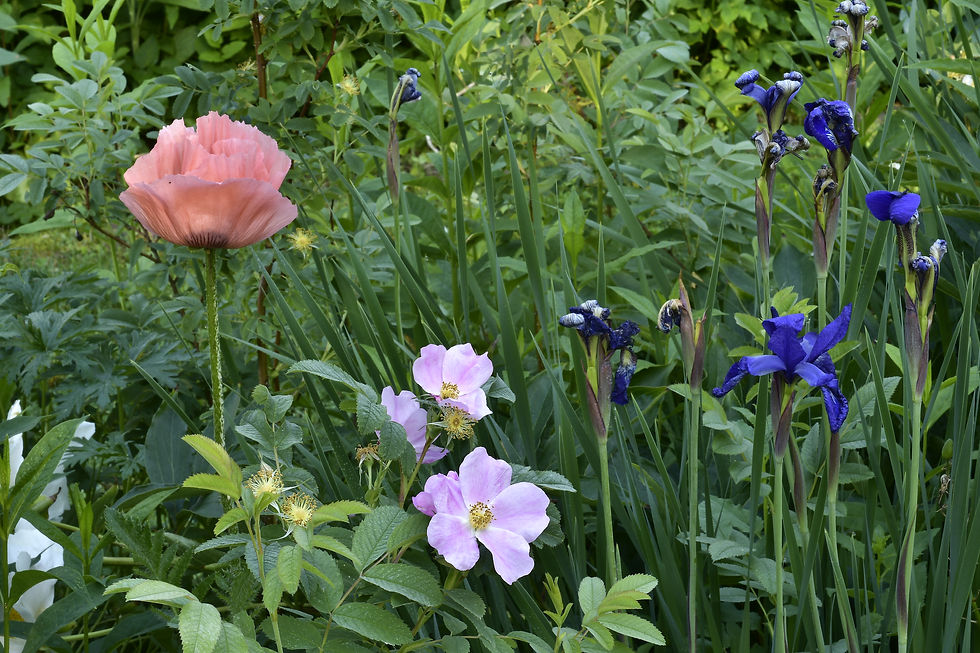
Siberian Iris (Iris siberica) and Poppies (Papaver hybrid) as seen above. For autumn combinations, consider any of a number of grasses, such as Switch Grass (Panicum virgatum) and Little Bluestem (Schizachyrium scoparium) or any of the Asters, such as Symphyotrichum racemosum pictured below in late September for a modest, yet well-blended design.

Other than removing a few of the oldest canes that are in decline, there is very little maintenance required! The plant has proven to be highly resistant to the damaging Rose Rosette virus which has resulted in the culling of many roses. In addition, the plants remain free of most other foliar diseases, such as blackspot! Plants are easily grown in a variety of soils, ranging from silty to sandy and moist to dry. The key is for the soil to drain well and not be prone to standing water. Smooth Rose grows well in lightly acidic to alkaline soils and, although they prefer full sun, they are tolerant of partial shade. At Willowwood Arboretum, the plants grow to heights of 3-4’, although they are reported to reach heights of 5’+, depending on the height of the competing vegetation.
This also appears to be a rose that has yet to attract the attention of many gardener and breeders since, to my knowledge, there are no selections available on the market! Perhaps this is because Rosa blanda is grown more for its habit and multiple seasons of interest than just its blooms. In fact, I can think of few other plants that offer attractive blooms in spring, great fall color with attractive red hips and colorful stems for winter interest. Combined with its absence of ‘thorns’, William Aiton could not have crafted a better species name, as this truly is a most alluring rose!

Bruce Crawford
Manager of Horticulture, Morris County Parks Commission


Comments