
Sweeping Together New Garden Visions
During my drive to work, I pass a number of homes whose landscapes mostly consist of a tidy row of shrubs paired with a neatly trimmed lawn. The spring may offer some floral enhancement, but by-and-large, the landscapes remain a steadfast green. Few homeowners consider replacing some of those shrubs and the lawn with a stylized meadow featuring sweeps of various flowering perennials and grasses. This style of design provides color, texture and a much-needed habitat for our insects and pollinators. Should a meadow be on your wish list, an indispensable grass for wildlife and seasonal beauty alike is Little Bluestem or Schizachyrium scoparium. Sweeps of the grass (pictured at below at Chanticleer Gardens) interplanted with various flowering forbs provides the perfect solution for a low maintenance yet colorful and environmentally friendly garden.

Schizachyrium is a member of the Poaceae or Grass Family with around 60 species native to North and South America, Africa, India, Southern Asia, Japan and Australia. Schizachyrium scoparium is native to most of the US, excluding the states of Oregon, California and Nevada. It is also native to southern portions of Canada and is an integral part of tall grass prairies, even though it only reaches 2-4’ tall on average. It was originally named Andropogon scoparius in 1803 by the French botanist André Michaux (1746-1802). Today Andropogon contains over 100 species and although Little Bluestem remained in the genus for 100 years, its classification was constantly being questioned. In 1829 the well-respected German botanist Christian Gottfried Daniel Nees von Esenbeck (1776-1858) crafted the genus Schizachyrium from the Greek Schizein, meaning to split or cleave and Achyron for chaff, describing how the protective leafy bracts or Lemma found covering the florets are split. Finally, in 1903 the American botanist and Head Gardener for the NY Botanic Garden, George Valentine Nash (1864-1921) reclassified the plant, naming it Schizachyrium scoparium. However, change comes slowly in horticultural circles and Andropogon was still in common use when I first learned this species! Fortunately, that has since changed although I cannot help but wonder if the tongue twisting nature of Schizachyrium was part to blame! The species epithet is from the Latin Scopa for broom, describing how the plant resembles a broom during the late summer and fall!
Little Blue Stem is a warm season grass, showing few signs of life until mid-May, especially in more northern regions. When the foliage initially appears, it has an upright habit resembling a startled porcupine and does not assume the more typical arching form of grasses until early June. The leaves have an attractive, light blue color and grow 1-3’ long by ¼-⅜” wide. They vary from flat, to keel-shaped, to slightly inwardly rolled along their length. Ultimately, they yield a 1-2’ tall plant by mid-June. Come mid-August, the foliage starts to assume some of the red tones characteristic of autumn.


As with most all members of the grass family, the narrow foliage and culms (flower stems) provide a wonderfully slender and delicate texture for the garden that sways gracefully in the breeze. In addition, the plants also provide glistening flowers! The flowers are wind pollinated and have a terminology considerably different from insect pollinated flowers. For Little Blue Stem, the uppermost portion of each culm features from 2-12 short, 2-3” long branchlets or racemes.

In some literature, these racemes are called rams. Each raceme has 6-13 glistening spikelets that are oppositely arranged along the structure. A spikelet is comprised of one or more individual florets that contains male and female reproductive organs. These florets are enclosed by two leafy bracts called Lemma, which are split at the tip. This leafy Lemma falls under the general description of ‘chaff’ and it was these partially split Lemma that inspired von Esenbeck to name the genus Schizachyrium or ‘split chaff’! The florets may not be particularly colorful, especially when compared to flowers, but they do have the unique quality of playing with light. The racemes are densely covered with fine white hairs that initially lay flat or appressed. As the florets of the spikelets mature, the hairs stand upright and give the outstretched racemes a glistening, silvery effect starting in September.
The hair laden racemes are only the start of the fall display. As the culms start to appear in mid-summer, they initially have an attractive powder blue appearance. Every 3-4” along the culm a slight bulge appears termed a node, from which a short blade of grass will arise. These grass blades grow progressively smaller the further up the culm they appear. The base of the leaf blade, called a sheath, is wrapped around a portion of each culm segment. Starting in early September the individual segments of each culm turn an attractive red, while the lower leaf sheath initially retains its blue color, providing a two-tone effect.
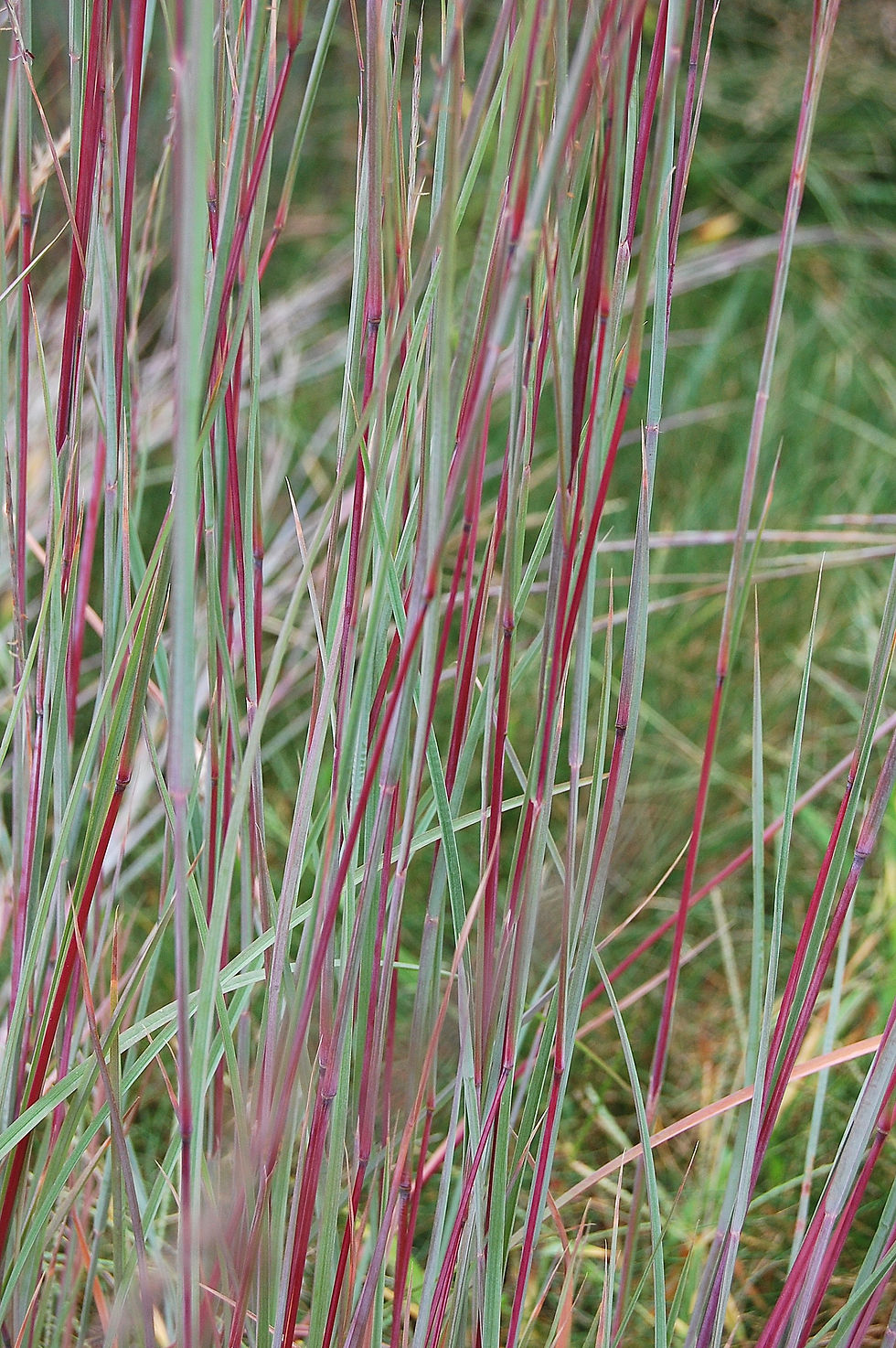
As the temperatures continue to cool in October, the leaves also turn red, with the entire plant assuming a bright red or orange color that truly lights up the autumn landscape!

The plants turn tan come winter, although they still retain an underlying red glow. It was this wonderful transition of color and the sparkling racemes that earned the plant the 2022 Perennial Plant of the Year award!
Owing to the plant’s expansive native range its only logical for numerous cultivars to have been selected. One selection I have long applauded is ‘Standing Ovation’. Its ability to resist from taking a bow midseason is what makes it an exceptional plant! Many seedling-grown plants exhibit a trait called lodging when grown in more fertile soils; the rapid growth of the plant results in weaker stems, causing it to collapse or lodge in late summer and autumn.

Unless the soil is excessively rich, the stronger blue stems of ‘Standing Ovation’ enable it to grow to 4’ tall without the fear of collapsing. Aside from the stronger stems, it develops the same wonderful flowers and fall color, typical to the species. Combined with the chartreuse Autumn Moor Grass (Sesleria autumnalis), it makes for a season-long fine textured combination.

The design could have been enhanced through the addition of a low spreading plant, such as the blue flowered Wild Geranium (Geranium maculatum), which would help suppress weeds in the area between the plants and add some additional, early season color! Of course, adding more plants and planting them closer would have reduced the potential for weeds as well!
Another nice cultivar whose name says it all is ‘The Blues’! Selected by Kurt Bluemel (1933-2014), one of the foremost leaders in ornamental grasses, it was named by Dale Hendricks of North Creek Nurseries. ‘The Blues’ has distinctive, light blue foliage and is ideal for lower fertility soils. A more recent introduction is ‘Ha Ha Tonka’. The plant originated from a seed collecting trip by the German Horticulturist Cassian Schmidt to Ha Ha Tonka State Park in Missouri. Schmidt and landscape designer Piet Oudolf evaluated the seedlings from this expedition and selected what they considered to be the most attractive. What makes this selection unique is the densely pubescent foliage that allows it to retain droplets from a heavy morning dew or summer rain, adding a whole new dimension to the garden!

The leaf sheath is also ‘hairy’, giving the flower stems the same fuzzy appearance and serves to enhance the fall colors.

Both ‘The Blues’ and ‘Ha Ha Tonka’ reach 2-4’ tall and although I have seen ‘The Blues’ lodge in richer soils, ‘Ha Ha Tonka’ appears more resistant.
Although not preferred by deer, Little Blue Stem does provide many benefits for wildlife! The seed is eaten by song birds and upland game birds, while pieces of the foliage provide the structural building blocks for native bee colonies. It is a host plant for Skipper Butterfly caterpillars who overwinter in tubes made from curled leaves and it provides habitat for nesting and roosting bird species. Little Bluestem also proves to be an easy plant to maintain! In early spring I simply cut the leaves and culms into 4” long pieces that I merely spread around the base of the plants as mulch! No need to haul it away and by late April, the new growth of neighboring flowers or bulbs have already concealed the cut pieces! Plants prefer well-drained, gritty soils with a pH near neutral, although plants are adaptable to acidic or alkaline soils. Growing well in zones 3-9, plants are able to endure very poor soils and actually develop the best structure and color in well-drained soils with lower nutrition. Its ability to thrive in poor soils earned it yet another common name of Poverty Grass.
Throughout the growing season it makes a nice companion for flowering plants that also relish good drainage. Consider pairing it with the lower growing Harebell (Campanula rotundifolia), whose blue, bell-shaped flowers appear from June through fall or with some of the taller Sedums, such as ‘Autumn Joy’. The foliage also pairs nicely with the silvery blue foliage of Donkey Tail Spurge (Euphorbia myrsinites) or the silver flowered Rattlesnake Master (Eryngium yuccifolium) that stretches to 4’tall. In fact, the blue foliage of Schizachyrium makes a nice compliment to any silver foliaged plant, including the tropical Fragrant Bromeliad (Vriesea odorata), where its transparency also serves to add depth to the composition. Come fall, the fiery fall color can nicely compliment the red and orange foliage of Beardtongue (Penstemon digitalis). The design options are nearly endless!
The merits of meadow inspired designs have long been touted for their ability to look great and support beneficial insects while reducing both irrigation and fertilizing. This style has yet to become mainstream since it often does not fit the style considered appropriate by many homeowners and towns alike. I remain hopeful that plants such as the broom-like Schizachyrium, with its seasonal beauty and ease of maintenance will start to ‘sweep together’ visions of a more sustainable style of urban Gardening in the years to come!

Bruce Crawford – Hort Manager, Morris County Parks Commission


Comments