
A Story That Never Grows Old
All plants have a story to tell, but few are as well-known as the fossil strewn story of Dawn Redwood. Botanically known as Metasequoia glyptostroboides, the plant was thought to be long extinct and was only known from fossils until a tree was suddenly noticed along a roadside in China during 1941. A beautiful tree, I have long admired the specimen at Willowwood Arboretum (as seen below) for its form, texture and color. My understanding of its ‘story’ was recently expanded when I read Metasequoia After 50 Years in Arnoldia, the Magazine of the Arnold Arboretum. I thought it only fitting to share!

Metasequoia is currently a member of the Cupressaceae or Cypress Family. It was initially placed in the Taxodiaceae or Bald Cypress Family until this family was found to actually be part of the Cupressaceae. The genus name was created in 1939 by the Japanese botanist Shigeru Miki (1901-1974) from fossils uncovered near Tokyo. The name is derived from the Greek Meta, meaning ‘along with’ or ‘among’ and Sequoia, the genus of the California Redwood (Sequoia sempervirens). It describes how this genus is similar to or resembles the California Redwood, although it is not evergreen. While the actual living tree and the fossils studied by Miki were found in Asia, the fascinating part of the story is how the plant and the countless fossils left behind gradually moved across an extensive portion of the northern hemisphere.
In Arnoldia’s Metasequoia After 50 Years, Dr. Hong Yang of the Harvard Radcliff Institute highlighted the gradual movement of the tree over a broad range of the Northern Hemisphere. The tree is believed to have initially evolved in Eastern Russia around 100 Million Years Ago (MYA). Based on these early fossil records, it became apparent the plant has changed little over the years and evidently has always preferred moist and temperate climates. It is these preferred climatic conditions that drove the tree’s gradual movement throughout much of the northern hemisphere as the climates fluctuated. Initially, the plant spread south into Japan and east into North America via the Bering Land Bridge connecting Eastern Russia with Alaska. As temperatures moderated around 60 MYA, the plant followed the warmer temperatures North into regions around the north pole and East into Northern Europe. The temperatures once again cooled 40-35 MYA, pushing the preferred habitat and the tree south into central Eurasia. As the climate warmed around 14 MYA, the plant once again moved north into the Arctic Circle, only to vanish from North American and Eurasia by 5 MYA. The one region where the plant still remained was in Japan. During the last Ice Age, known as the Pleistocene Ice Age that persisted from roughly 2.6 million to 12,000 years ago, a land bridge developed between Japan and China around 1 MYA. It is believed this bridge allowed plants of Dawn Redwood to enter into China and become established in their current growing region in the southwestern Province of Hubei. The plant vanished from Japan as the temperatures grew colder. Fortunately, the Daba mountain range to the north of its new home in China provided the needed protection from the desiccating and icy winds, allowing the plants to survive.
This area of China was still very remote in the 1940’s and aside from the Yangtze River, access was limited. At an elevation of 3,200-4,000 feet the climate is cool and rainy with rice farming serving as the primary source of commerce. In part, it was its remoteness that explained why the plant was never noticed until the winter of 1941 when Professor T. Kan of the Department of Forestry noticed this unusual plant growing along a roadside. The local residents called the plant Shui-sa or Water Fir, owing to its love of moist sites. The tree was brought to the attention of the Chinese botanist and scholar Hsen-Hsu Hu (1894-1968) who, along with fellow Chinese botanist Wan Chun Cheng (1908-1987) properly named and described the species in 1948 as Metasequoia glyptostroboides. I have always found the species name to be a bit of a tongue-twister, but the root of the name is very logical. When the plant was initially found, it was thought to be Glyptostrobus pensilis, commonly called Water Pine. By adding the Greek suffix of Oides, meaning ‘resembling’ or ‘like’, the authors paid homage to how Dawn Redwood resembles the Water Pine! The origin of the common name actually preceded the botanical name by several months and was coined by the San Francisco Chronical. It illustrated how this recently discovered plant was seemingly as old as the dawn of time!
Hu was also the first resident of China to receive a Doctorate in Botany from Harvard University. During his studies, he came to know Dr. Elmer D. Merrill (1876-1956), who served as the Director of the Arnold Arboretum from 1935-46 and remained on as a professor until his passing. Realizing the significance of this find, Hu reached out to Merrill for a stipend of $250 to support the cost of travel for obtaining some seed, which Merrill quickly provided. This journey was no minor ordeal, as it entailed traveling by boat along the Yangtze River followed by a 3-day journey on foot! To compound the challenges, the route by foot was along steep mountainside trails, at times only one foot wide, making both footing and passing other travelers difficult! The remoteness of this route also made it attractive for thieves who robbed and on occasion murdered travelers. Traveling at night was sometimes the safest route. Miraculously, one small package of seed was sent back to the Arnold in January of 1948 while a larger package arrived later that year in March. The seeds were in turn sent to 76 different institutions, including Princeton University where their head horticulturist, Jim Clark germinated the gifted seeds. In 1950, Clark provided three seedlings to the Tubbs Brothers at Willowwood, where I and numerous visitors have come to know the tree 70 years later!

With such an interesting story of its movement throughout the northern hemisphere and finally its discovery, it is fortuitous for gardeners that Dawn Redwood is also extremely attractive! Dawn Redwood develops a very pronounced central leader as seen in the opening image and can grow to well over 100’ tall with a very symmetrical, pyramidal form. As it approaches maturity, the top of the plant becomes more rounded or even flat-topped. The bark is a rich reddish brown with ropey plates running vertically up the trunk while the base of the trunk has a very pronounced root flair (as seen above at Willowwood Arboretum). This flair is enhanced when planted in a moist location – a trait seen in various other tree species and is thought to improve stability in marshy soils.

With a touch of imagination, each undulation of the trunk combined with the pronounced root flair gives the appearance of the lower legs and feet of a Mastodon! Unique to this species, plants develop pronounced depressions under the branches which resemble armpits, as Professor Dr. Bruce Hamilton of Rutgers University would frequently note! Interestingly, these armpits remain long after the branch is gone (as seen above at the Morris Arboretum), making it suitable for mythical landscapes befitting of J. R. Tolkien’s The Hobbit!
The foliage is glossy and dark green, and at a casual glance appears to be a pinnately compound leaf since there is a central stem with numerous, 1” long by ⅛” wide leafy segments arranged along both sides of this stem. In actuality, they are 3-4” long leafy branchlets that are arranged oppositely along the stems, sometimes referred to as Pin Branchlets.

In November, the leaves turn a fiery orange for several weeks (as seen above) and despite the quantity of leaves produced, the fallen branchlets often filter into lawns after a few passes with the lawnmower and are not a major issue.
The plants are monoecious, meaning one plant bears both male, pollen releasing cones as well as female seed-bearing cones. The male cones remain on the plant for around 9 months while female cones persist for around 18 months! The clusters of male cones start to develop in

mid-June along the terminal 3 or 4 leafy branchlets. These branchlets are easily distinguished from regular foliage by the sparse number of leaflets and their tendency to dangle downward at the branch tips (as readily seen in the image above in mid-October). A close-up of these

developing light tan cones can be seen above, again in mid-October.
Typical to most conifers, the male cones are located on lower regions of the tree while the female cones have a ‘room with a view’, appearing in clusters on the uppermost branches. Since pollen is light, it can float upward via wind gusts to the female cones while the lofty location of the female cones allows the winged seed to be propelled farther via the wind. As seen below in mid-March,

there is a distinct line where the male cones transition to their female counterparts. Mid-March is also the month when the mature male cones split open allowing the release of pollen! The resulting seeds (pictured below) are obovate or heart-shaped with a ⅟16” +/- wide wing on either side.

The female cones also reveal why the plant was originally confused with Glyptostrobus (Water Pine). The name Glyptostrobus is a mix of the Greek Glyptos meaning carved and Strobilus for cone, describing how the grooved cones of Water Pine appear to be carved. The small cones of Dawn Redwood are about an inch in diameter and when studied carefully, they too appear carved. In this case the carvings are of puckered lips etched into the outer edge of each scale (as seen above)! Unlike most conifers that release clouds of pollen in mid- spring, Dawn Redwood is far more conservative as I have never seen billowing clouds of pollen drifting about the tree! By the following fall, the seeds are ripe. Interestingly, the seeds are often not dispersed until the following spring when the cones finally dry to the point whereby seed can be released. Seeds will germinate later that first spring and grow to 3-4” tall by the onset of frost!
There are also a few noteworthy selections available in the trade. ‘National’ is a release from the National Arboretum and features a narrower growth habit. If a dash of yellow is your preference, consider ‘Ogon’. Found in a Japanese nursery around 1993 by the Dutch horticulturist Peter Zweinburg, the plant offers attractive bright yellow foliage throughout the growing season with the same russet fall color. Zweinburg altered the name to ‘Gold Rush’, although I have yet to see this name in the trade.
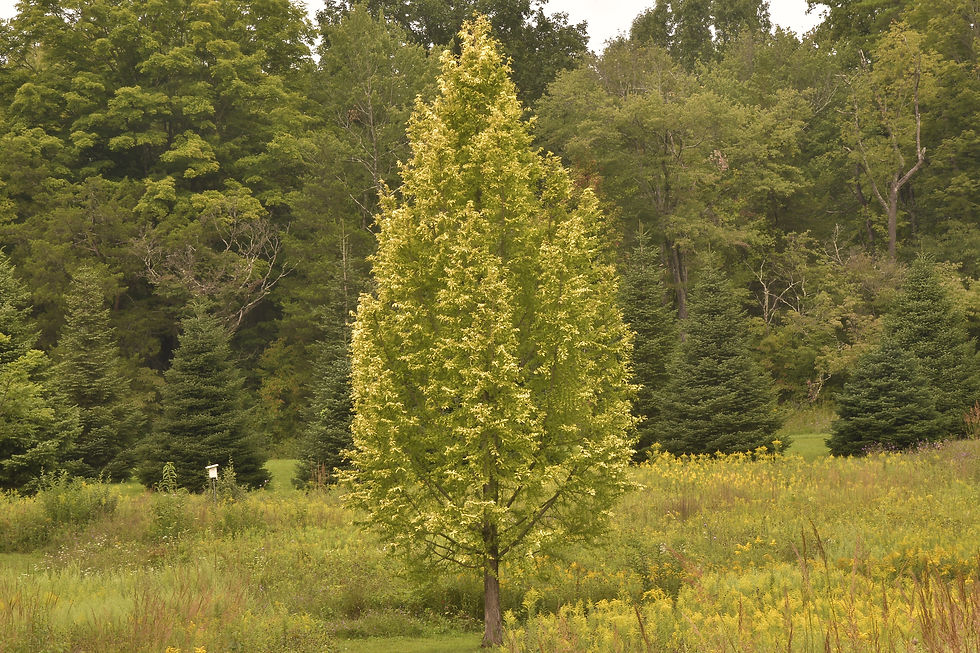
The plant is purported to grow at a slower rate, although the tree at Willowwood (as seen above in early September) and another at Chanticleer Garden are both growing at a most handsome pace.
As the Chinese name of Water Fir suggests, plants enjoy a location which remains moist but well-drained, such as along a stream bank. So long as the temperature remains warm and moisture ample, the plants will grow indeterminately until the conditions change, which explains their rapid growth in warm, moist locations. The 1952 planting along the Wissahickon Creek at Morris Arboretum in Philadelphia by Dr. Hui-Lin Li typifies this ideal environment (as seen in the closing image below). The trees were planted near the bank of the stream, allowing ample access to water. These trees were underplanted with Ostrich Fern (Matteuccia pensylvanica), providing a vision of what regions of the world could have looked like 60 MYA! Plants can also thrive in humus rich soils that are not always wet. At Crystal Springs in Hamburg NJ (pictured below), a tunnel-like effect was created by planting several Dawn Redwoods on either side of a

curving walk and judiciously removing some of the lower branches. The trees were underplanted with Hydrangea arborescens ‘Annabelle’ to enhance the tunnel-like effect and the mystery of what awaits beyond the far end!
Metasequoia glyptostroboides is certainly a mouthful that rarely rolls off your tongue with ease. However, if room avails it provides a beautiful addition to your garden. It also provides the opportunity of recanting its interesting history. If you wish to learn more of its story, I encourage you to read Arnoldia (issue 58/4*59/1, 1999) that is available online. I have had the pleasure of working with the NJ state champion at Willowwood Arboretum for the past 5+ years and retelling its story to numerous visitors. It is a story that never grows old!

Bruce Crawford
Manager Horticulture, Morris County Park Commission


Comments